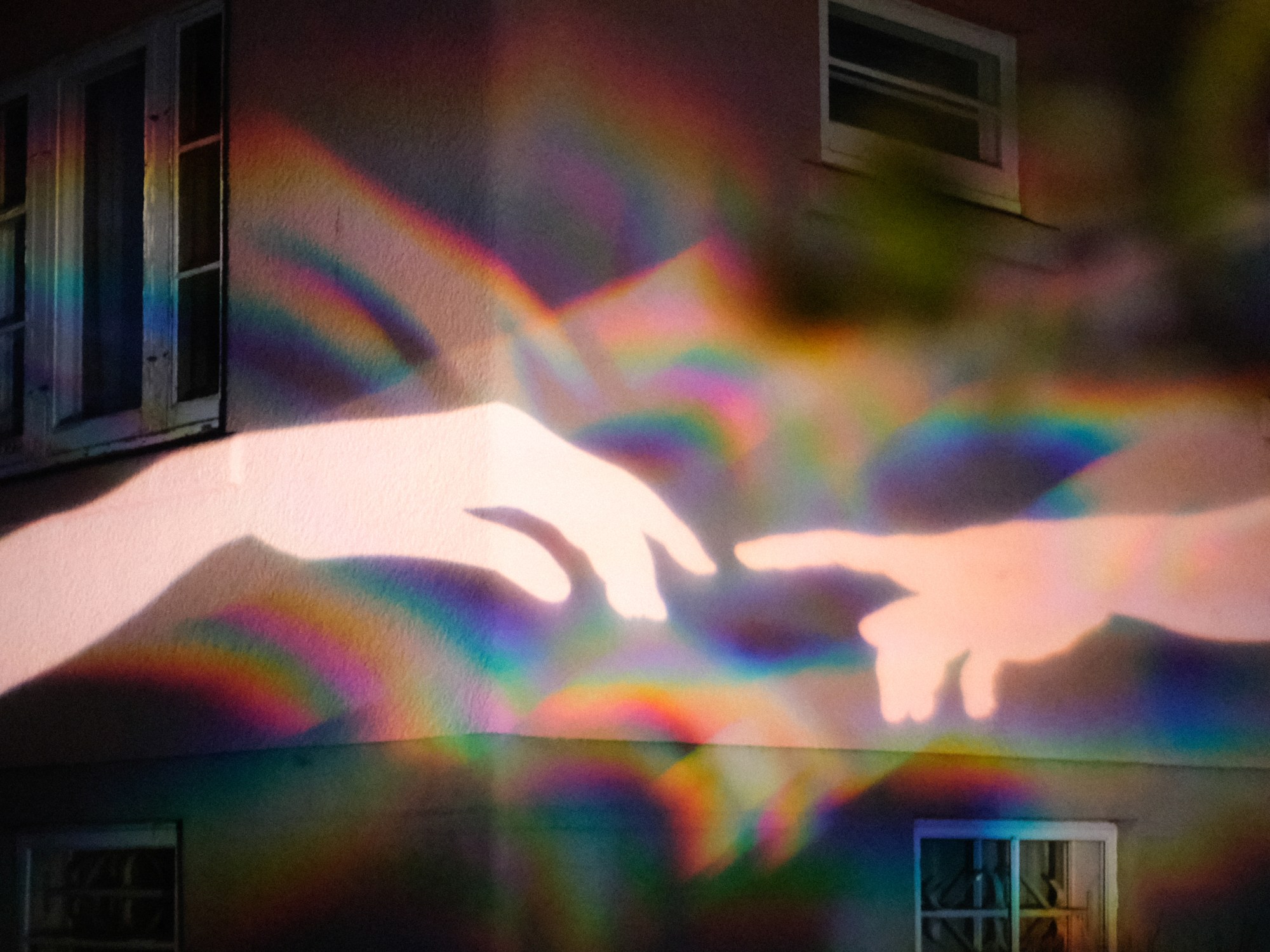
The Future of Touch:
a conversation between artists making interactive, social, participatory, or public artworks in the wake of COVID-19

On May 22, 2020, over 65 artists, curators, choreographers, exhibit designers, dancers, musicians, performers, and arts administrators from North America and Europe participated in The Future of Touch. The conversation was online, free, and artist-run, intended to further touch-based discussions and predictions for the near future in a time marked by COVID-19 and subsequent touch-fears.
The Future of Touch was facilitated by Caitlind r.c. Brown & Wayne Garrett.
This multi-media essay is a document of the resulting conversation.
Part 1: Introduction
| What is the Future of Touch? |
We are currently encountering a crisis of touch. We are not the first – those with compromised immune systems, contagious diseases, and certain mental health concerns have been here before – but the present touch-fear is shared in unison around the globe, as tangible and invisible as the Coronavirus itself. Humans of this era are always trying to expand themselves beyond their physical bodies, to reach further, to touch more. Sometimes touch is colonial, capitalist, or worse – more like a grab, a precursor to taking something. Often, however, touch is more reciprocal, intended to build connections between.
My particles reach for yours, and though they never entwine, the desire to be closer has expressed itself.
Touching a thing is associated with believing in its realness. Cultural touch varies widely, as does the prevalence of interpersonal touching: handshakes, cheek kisses, hugs, and so forth. Those without vision learn to read with their hands and ears. Small children shape distance, scale, and form through touch. Whether touching objects, each other, or other living things, the inherent value of touching the world is indisputable. Because of this, we know that touch will recover from this current touchless moment. After all, pandemics have come and gone before; we are all the unlikely survivors of thousands of catastrophes, followed by touch.
Prior to this pandemic, touch had been growing increasingly prevalent in contemporary art, certainly under the rising popularity of “interactive art,” but also as a reflection of the increasingly diverse ways art can be experienced in the 21st Century.
So what about now? What about these months and (potentially) years where touching is discouraged, gatherings are self-aware, and germs are almost visible hanging in the air between us?
Whether making art in specifically touch-based mediums, or broadly people-oriented situations, artists working in the social sphere have undoubtedly considered the impacts of COVID-19 on their practice. How have their interpersonal philosophies already been shaped by this historic moment? How are they thinking about togetherness now? What does it mean to facilitate touch responsibly through the lens of our current experience? How can we learn to touch again*?
*Paraphrased from a recent Instagram Live interview between artist Karina Smigla-Bobinski and OMM Museum (Turkey)
Part 2: Keynote Speakers
| Speaker 1: Kurtis Lesick (artist, professor, theorist) “Being in an excess of touch” |
In the light of the Covid19 pandemic, and thinking through philosophy and performance, Lesick asks “how do we approach an existence without touch, or perhaps more accurately phrased, how do we approach an existence where the world is opened up so that all-is-touching?”
| Speaker 2: Sara Meunier (MD, BSc) “The Neuroscience Power Hour (in 10 Min)” |
Dr. Sara talks about the endogenous opioid system as it relates to reward and social bonding, and creative ways we can try to harness this system without touch.
| Speaker 3: Karina Smigla-Bobinski (artist) “Touch in Art Practice” |
How can art develop through the collaboration of public, and how can interactive art “teach us to touch and socialize again” through hands-on experience?
Part 3: Artist Conversation
After the keynote presentations, we broke into 9 sub-groups to discuss The Future of Touch. The following segments represent anonymous snippets of dialogue from artists participating in those conversations. Segments are categorized into reoccuring themes. You may listen to these clips in whatever order you desire, but bear in mind that no single segment encompasses the entirety of our conversation.
Thank you for listening to The Future of Touch. Audio recordings were compiled and edited by Caitlind r.c. Brown, with music by Wayne Garrett, and recording support from Alia Shahab, Andrew Frosst, Chad Saunders, Jennifer Crighton, Laura Anzola, Matthew Waddell, Mark Hopkins, and Wayne Garrett. Thanks to Kurtis Lesick, Sara Meunier, and Karina Smigla-Bobinski for their keynote presentations. Special credit to Nikki Tambourine for all the conversations leading up to this one. Biggest thanks to all of our participants from near and far.
The Future of Touch was facilitated by Calgary-based artists Caitlind r.c. Brown & Wayne Garrett. While folks joined The Future of Touch from near and far, our home is located in Calgary/Mohkinstsis on the traditional territories of the Blackfoot Confederacy, the Tsuut’ina and Stoney Nakoda First Nations, and the Métis Nation of Alberta (Region 3). Wherever you are, please take a moment to acknowledge the land you’re touching, and the implications of that contact over time.


 Caitlind r.c. Brown & Wayne Garrett
so topical…much thought will be needed by artists and everyone.. should be really interesting….good on ya! xo m
On Mon, May 11, 2020 at 9:18 PM Caitlind r.c. Brown & Wayne Garrett wrote:
> jellyfishwish posted: ” Notes to the Neighbourhood #9, analog house > projections during self-isolation The Future of Touch: an open conversation > for artists making interactive, social, participatory, or public artworks > in the wake of COVID-19 Friday, May 22, 202″ >